Velimir ("monty") Vesselinov
Science-informed AI/ML, geoscience modeling, uncertainty quantification, and open scientific software.
Research profile featuring publications, presentations, reports, software, and linked scientific work across geoscience, uncertainty quantification, and AI/ML-enabled decision support.

Machine learning and artificial intelligence for earth and environmental systems.
Model diagnostics, uncertainty quantification, inverse analysis, and decision support.
Scientific software development spanning hydrology, geoscience, and high-performance computing.
Browse Sections
Expand the sections below to explore background, research directions, projects, software, workshops, and archival materials.
01SectionAbout meOpen
My expertise is in applied mathematics, computer science, environmental management and engineering.
My research interests are in the general areas of machine learning (ML), artificial intelligence (AI), data analytics, model diagnostics, and cutting-edge computing (including high-performance cloud, quantum, edge).
I am the inventor and lead developer of a series of novel theoretical methods and computational tools for ML/AI. I am also a co-inventor of a series of patented ML/AI methodologies.
Over the years, I have been the principal investigator of numerous projects. These projects addressed various Earth-sciences problems, including geothermal, carbon sequestration/storage, oil/gas production, climate/anthropogenic impacts, wildfires, environmental management, water supply/contamination watershed hydrology, induced seismicity, and waste disposal. Work under these projects included various tasks such as ML, AI, data analytics, statistical analyses, model development, model analyses, uncertainty quantification, sensitivity analyses, risk assessment, and decision support.
Currently, I am running my own private business with Trais Kliphuis called EnviTrace LLC. I am Co-Founter, CTO, and CSO at the company. We are developing Science-Informed AI/ML methods and software tools for environmental, climate, and energy problems. Special focus are geothermal and groundwater contamination problems.
My Ph.D. (University of Arizona, 2000) is in Hydrology and Water Resource Engineering with a minor in Applied Mathematics. My adviser was Regents Professor Shlomo P. Neuman.
I joined LANL in 2000. At LANL, I have been involved in numerous projects related to computational earth sciences, big-data analytics, modeling, model diagnostics, high-performance computing, quantum computing, and machine learning. I have authored book chapters and more than 130 research papers cited more than 3,000 times with h-index 30 (Google Scholar).
For my research work, I received a series of awards. In 2019, I was inducted into the Los Alamos National Laboratory’s Innovation Society.
I am also the lead developer of a series of groundbreaking open-source software tools for machine learning, data analytics, and model diagnostics. These tools are actively used worldwide by the community and are available on GitHub and GitLab.
One of these software platforms is SmartTensors: a general framework for Unsupervised, Supervised, and Physics-Informed Machine ML/AI. In 2021, SmartTensors received two R&D100 awards.
Another key software framework is MADS: an integrated high-performance computational framework for data analytics and model diagnostics. MADS has been integrated in SmartTensors to perform model calibration (history matching), uncertainty quantification, sensitivity analysis, risk assessment and decision analysis based on the SmartTensors ML/AI predictions.
02SectionWork ExperienceOpen
2021 - present: Co-Founder, CTO, CSO, EnviTrace LLC, Santa Fe, New Mexcio, USA
2021 - present: Founder, CEO, SmartTensors LLC, Santa Fe, New Mexcio, USA
2022 - 2023: CTO, Carbon Solutions LLC, Bloomington, Indiana, USA
2000 - 2022: Senior Scientist, Los Alamos National Laboratory, Los Alamos, New Mexcio, USA
1995 - 2000: Research Associate, Department of Hydrology and Water Resources, University of Arizona, Tucson, Arizona, USA
1989 - 1995: Associate Professor, Department of Hydrogeology and Engineering Geology, Institute of Mining and Geology, Sofia, Bulgaria
03SectionResearchOpen
- Machine Learning
My primary research focus is on developing unsupervised (self-supervised) and physics-informed ML methods.
The methods utilize Matrix/Tensor Decomposition (Factorization) coupled with physics, sparsity and nonnegativity constraints. The methods are capable to reveal the temporal and spatial footprints of the extracted features.
SmartTensors
SmartTensors is a general framework for Unsupervised and Physics-Informed Machine Learning and Artificial Intelligence (ML/AI).
SmartTensors incorporates a novel unsupervised ML based on tensor decomposition coupled with physics, sparsity and nonnegativity constraints.
SmartTensors has been applied to extract the temporal and spatial footprints of the features in multi-dimensional datasets in the form of multi-way arrays or tensors.
SmartTensors algorithms called NMFk and NTFk for Matrix/Tensor Factorization (Decomposition) coupled with sparsity and nonnegativity constraints custom k-means clustering has been developed in Julia
SmartTensors software packages are available as open source on GitHub.
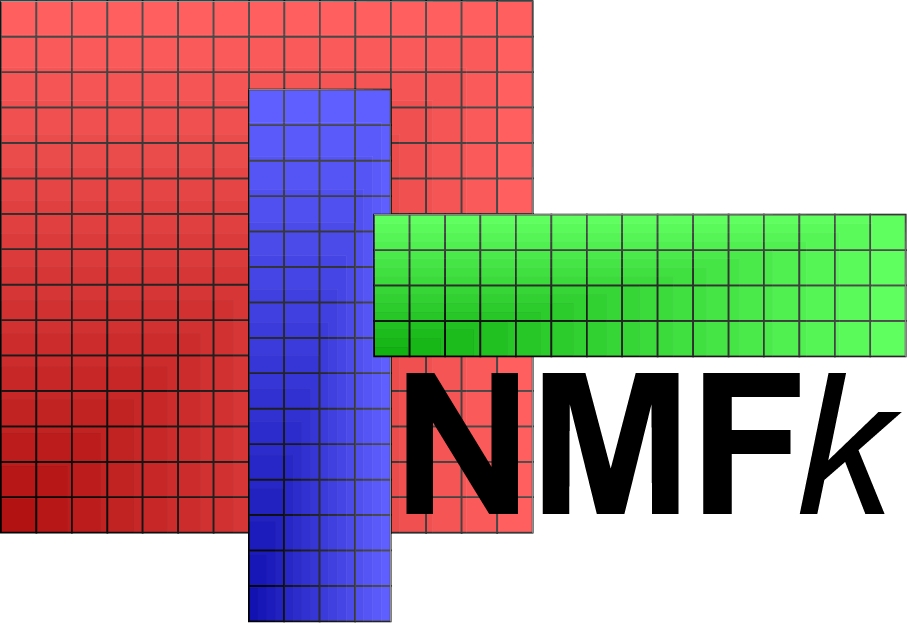
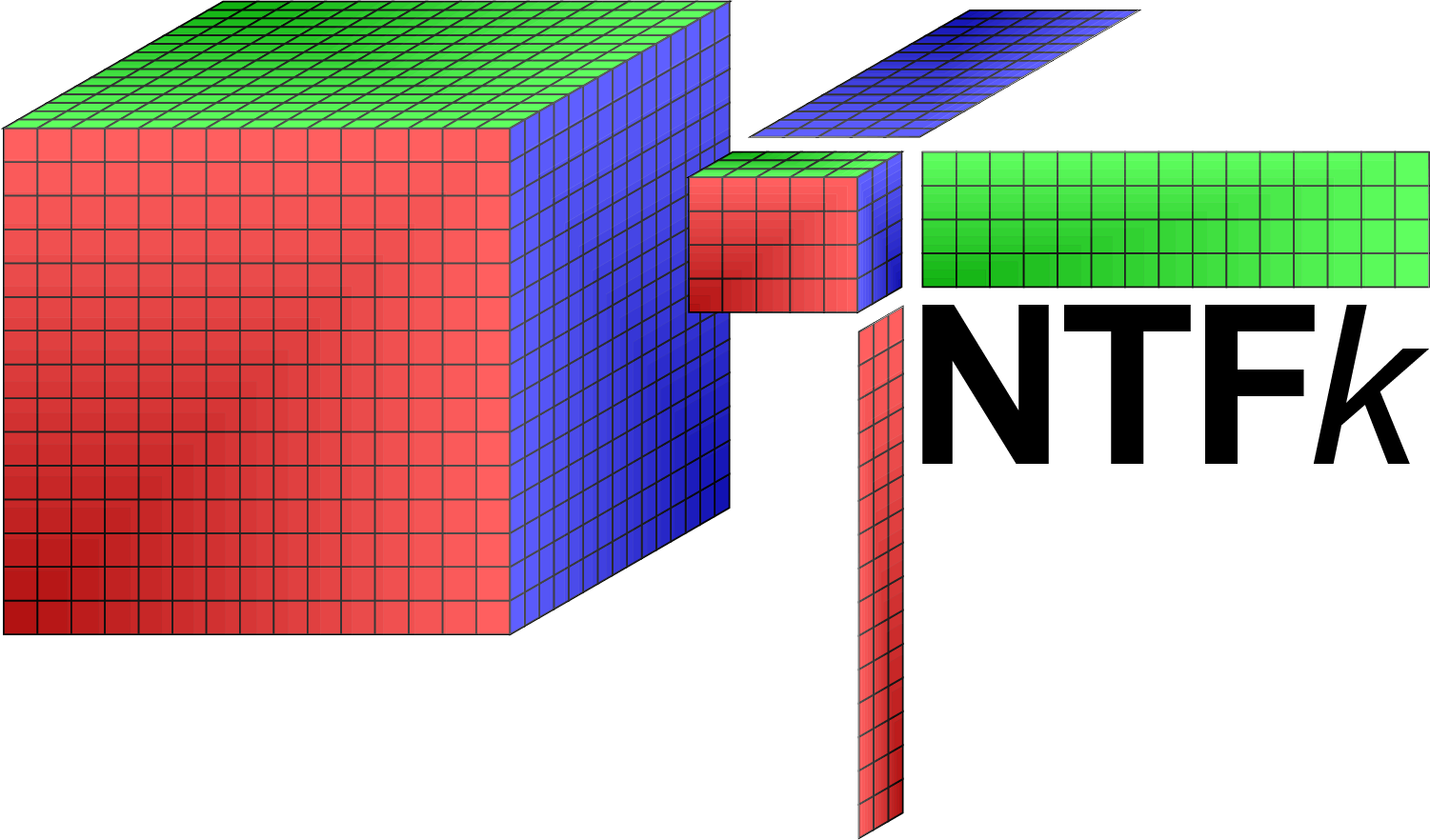
Other key methods/tools for ML include:
- RegAE.jl: a novel curring-edge methodology for performing inverse analysis. The main goal of this approach is to provide an efficient and general means of regularizing inverse problems where the parameter fields are high-dimensional and have coherent structures. RegAE.jl is intended to work for any general inverse problem without prior knowledge of the solved physics and how to properly perform the regularization. RegAE.jl leverages a Variational AutoEncoder (VAE) to learn how to regularize these problems based on unconditioned realizations of the high-dimensional parameter fields. RegAE.jl provides a computationally efficient means of obtaining an optimal solution by (1) easing the regularization process, and (2) reducing the dimensionality of the optimized parameter space. In addition, the application of adjoint methods (via automatic differentiation) during the RegAE.jl inverse analysis further reduces the computational cost.
- SVR.jl: Support Vector Regression (SVR) analysis.
- PhysicsInformedML.jl: Physics-Informed ML subroutines.
Research Papers:
- Vesselinov, V.V., Mudunuru, M., Karra, S., O'Malley, D., Alexandrov, B.S., Unsupervised Machine Learning Based on Non-Negative Tensor Factorization for Analyzing Reactive-Mixing, 10.1016/j.jcp.2019.05.039, Journal of Computational Physics, 2019. PDF
- Vesselinov, V.V., Alexandrov, B.S., O'Malley, D., Nonnegative Tensor Factorization for Contaminant Source Identification, Journal of Contaminant Hydrology, 10.1016/j.jconhyd.2018.11.010, 2018. PDF
- O'Malley, D., Vesselinov, V.V., Alexandrov, B.S., Alexandrov, L.B., Nonnegative/binary matrix factorization with a D-Wave quantum annealer, PlosOne, 10.1371/journal.pone.0206653, 2018. PDF
- Stanev, V., Vesselinov, V.V., Kusne, A.G., Antoszewski, G., Takeuchi,I., Alexandrov, B.A., Unsupervised Phase Mapping of X-ray Diffraction Data by Nonnegative Matrix Factorization Integrated with Custom Clustering, Nature Computational Materials, 10.1038/s41524-018-0099-2, 2018. PDF
- Iliev, F.L., Stanev, V.G., Vesselinov, V.V., Alexandrov, B.S., Nonnegative Matrix Factorization for identification of unknown number of sources emitting delayed signals PLoS ONE, 10.1371/journal.pone.0193974. 2018. PDF
- Stanev, V.G., Iliev, F.L., Hansen, S.K., Vesselinov, V.V., Alexandrov, B.S., Identification of the release sources in advection-diffusion system by machine learning combined with Green function inverse method, Applied Mathematical Modelling, 10.1016/j.apm.2018.03.006, 2018. PDF
- Vesselinov, V.V., O'Malley, D., Alexandrov, B.S., Contaminant source identification using semi-supervised machine learning, Journal of Contaminant Hydrology, 10.1016/j.jconhyd.2017.11.002, 2017. PDF
- Alexandrov, B., Vesselinov, V.V., Blind source separation for groundwater level analysis based on non-negative matrix factorization, Water Resources Research, 10.1002/2013WR015037, 2014. PDF
Presentations:
- Vesselinov, V.V., Novel Machine Learning Methods for Extraction of Features Characterizing Datasets and Models, AGU Fall meeting, Washington D.C., 2018. PDF
- Vesselinov, V.V., Novel Machine Learning Methods for Extraction of Features Characterizing Complex Datasets and Models, Recent Advances in Machine Learning and Computational Methods for Geoscience, Institute for Mathematics and its Applications, University of Minnesota, 2018. PDF
- O'Malley, D., Vesselinov, V.V., Alexandrov, B.S., Alexandrov, L.B., Nonnegative/binary matrix factorization with a D-Wave quantum annealer PDF
- Vesselinov, V.V., Alexandrov, B.A, Model-free Source Identification, AGU Fall Meeting, San Francisco, CA, 2014. PDF
Presentations are also available at slideshare.net
Videos:
- Vesselinov, V.V., Unsupervised and Physics-Informed Machine Learning of Big and Noisy Data, Bureau of Economic Geology, University of Austin, Texas, 2020.
- Vesselinov, V.V., Novel Machine Learning Methods for Extraction of Features Characterizing Complex Datasets and Models, Recent Advances in Machine Learning and Computational Methods for Geoscience, Institute for Mathematics and its Applications, University of Minnesota, 2018.
Examples:
- Data Analytics
Data analytics work executed under most of the projects and practical applications has been performed using the wide range of novel theoretical methods and computational tools developed over the years.
Key tools for data analytics include:
- ZEM: Integrated Framework for Real-Time Data and Model Analyses for Robust Environmental Management Decision Making.
- MADS (Model Analysis & Decision Support): a framework with a wide range of data pre- and post-processing capabilities (including visualization and statistical analyses). MADS can also perform various of data-based analyses.
- CHiPBETA: Correcting pressure head for pumping, barometric, & Earth Tide effects for data-analytics and model-diagnostics applications.
- Kriging.jl: Gaussian process regressions and simulations.
- Model Diagnostics
Model diagnostics work executed under most of the projects and practical applications has been performed using the wide range of novel theoretical methods and computational tools developed over the years.
A key tool for model diagnostics is the MADS (Model Analysis & Decision Support) framework. MADS is an integrated open-source high-performance computational (HPC) framework.

MADS can execute a wide range of data- and model-based analyses:
- Sensitivity Analysis
- Parameter Estimation (PE), Model Inversion and Calibration
- Uncertainty Quantification (UQ)
- Model Selection and Model Averaging
- Model Reduction and Surrogate Modeling
- Machine Learning and Blind Source Separation
- Decision Analysis and Support
MADS has been tested to perform HPC simulations on a wide-range multi-processor clusters and parallel environments (Moab, Slurm, etc.).
MADS utilizes adaptive rules and techniques which allows the analyses to be performed with a minimum user input.
MADS provides a series of alternative algorithms to execute each type of data- and model-based analyses.
MADS can be externally coupled with any existing simulator through integrated modules that generate input files required by the simulator and parse output files generated by the simulator using a set of template and instruction files.
MADS also provides internally coupling with a series of built-in analytical simulators of groundwater flow and contaminant transport in aquifers.
MADS has been successfully applied to perform various model analyses related to environmental management of contamination sites. Examples include solutions of source identification problems, quantification of uncertainty, model calibration, and optimization of monitoring networks.
MADS current stable version has been actively updated.
MADS software, source code, and example input/output files are available at the MADS website.
MADS documentation is available at github and gilab.
The C version of the MADS software is also available: MADS C website and MADS C source . A Python interface for MADS is under development: Python
Other key tools for model diagnostics include:
- AffineInvariantMCMC.jl: Integrated Framework for Real-Time Data and Model Analyses for Robust Environmental Management Decision Making.
- BIGUQ.jl: Bayesian Information Gap Decision Theory (BIG-DT) analysis for Uncertainty Quantification, Experimental Design and Decision Analysis.
04SectionSoftwareOpen

The software materials that were previously listed here have been migrated into the dedicated Software section.
The software catalog now combines software logos, migrated descriptions, links, and example imagery for the core open-source tools developed by Velimir V. Vesselinov.
- SmartTensors: science-informed AI and machine learning framework featuring NMFk and NTFk.
- MADS: model analysis and decision support framework for calibration, uncertainty quantification, and diagnostics.
- WELLS: analytical groundwater drawdown simulator with example outputs and supporting links.
See the full software catalog for the current structured overview.
05SectionProjectsOpen
Over the years, I have been the principal investigator or principal co-investigator of a series of multi-institutional/multi-million/multi-year projects funded by LANL, DOE, ARPA-E, and industry partners:
- SmartTensors: TCF (Technology Commercialization Fund) project funded by DOE for commercialization of the SmartTensors AI/ML framework (with JuliaComputing), 2021-2023
- ML4Geo: Machine Learning based Well Design to Enhance Unconventional Energy Production (with MIT, Stanford, University of Texas-Austin, JuliaComputing, Descartes Lab, and others), ARPA E, 2020-2021
- GeoThermalCloud: Cloud Fusion of Big Data and Multi-Physics Models using Machine Learning for Discovery, Exploration, and Development of Hidden Geothermal Resources (with Google, Descartes Lab, Stanford, and University of Texas-Austin), DOE EERE, 2019-2021
- CarbonSAFE: Carbon Storage Assurance Facility Enterprise project led by University of Wyoming (with Schlumberger and others), DOE EERE, 2020-2023
- OilPIML: Unsupervised and Physics-Informed Machine Learning for Oil/Gas Extraction from Tight Rock Unconventional Reservoirs, CRADA with Chevron, 2017-2021
- Tensor Train: Robust Unsupervised Machine Learning for Big-Data Analytics, LANL LDRD DR, 2018-2021
- Tensor Networks: Deep Unsupervised Machine Learning for Big Data Analytics, LANL LDRD DR, 2017
- DiaMonD: An Integrated Multifaceted Approach to Mathematics at the Interfaces of Data, Models, and Decisions, Mathematical Multifaceted Integrated Capabilities Center (MMICC), (with MIT, UT-Austin, ORNL, UC, Stanford, and others), DOE Office of Science, 2014-2018
- ASCEM: Advanced Simulation Capability for Environmental Management computational framework (with PNNL, LBNL, and others), DOE Environmental Management, 2007-2012
- LANL-EM: Environmental Management and Restoration of Regional Water Resources and Contamination Sites at Los Alamos National Laboratory, LANL Environmental Programs, 2001-2018
06SectionPatents / DisclosuresOpen
- Nair, R., Zaki, K.S., Li, Y., Rijken, P., Vesselinov, V.V., Geomechanics Informed Machine Intelligence (GIMI) US20220292338A1
- Pan, Y., Chang, O., Manley, S., Vesselinov, V.V., Machine Learning for Tight Rock Unconventional Well Production Forecast with Uncertainty Quantification
- Alexandrov, B.S., Vesselinov, V.V., Alexandrov, L.B., Stanev, V., Iliev, F.L., Source identification by non-negative matrix factorization combined with semi-supervised clustering US20180060758A1
07SectionCourses & WorkshopsOpen
- Ahmmed, B, Vesselinov, V.V., Machine Learning for Small, Uncertain, and Sparse Data Sets, American Geophysical Union, Fall Meeting, Chicago, IL, December 12-16, 2022.
- Ahmmed, B, Vesselinov, V.V., Unspervised Machine Learning, American Geophysical Union, Fall Meeting, December 1-17, 2021.
- Ahmmed, B, Vesselinov, V.V., Unspervised Machine Learning in Geosciences, Geological Society of America Annual Meeting, Portland, OR, October 10-13, 2021.
08SectionVideosOpen
- Vesselinov, V.V., et al., SmartTensors: Unsupervised Machine Learning, JuliaCon, Boston, MA, July 28-30, 2021. PDF YouTube
- SmartTensors for Unsupervised and Physics-Informed Machine Learning and Artificial Intelligence (ML/AI): a R&D100 award promotional video, 2021. YouTube
- Vesselinov, V.V., Unsupervised and Physics-Informed Machine Learning of Big and Noisy Data, Bureau of Economic Geology, University of Austin, Texas, 2020. YouTube
- Vesselinov, V.V., Machine Learning Deconstruction of the Oklahoma seismic events caused by oil/gas production activities, 2019. YouTube
- Vesselinov, V.V., Machine Learning for characterization of geothermal activities causing seismic effects at the Geysers geothermal field, 2019. YouTube
- Vesselinov, V.V., Machine Learning of the Phase separation of co-polymers, 2019. YouTube
- Vesselinov, V.V., Furusho-Percot, C., Goergen, K., Kollet, S., Machine Learning deconstruction of European air temperature fluctuations in 2003 using Terrestrial Systems Modeling Platform (TSMP) model outputs, 2018. YouTube
- Vesselinov, V.V., O'Malley, D., Machine Learning for charecterization of the LANL Chromium plume in the regional aquifer, 2018. YouTube
- Vesselinov, V.V., Novel Machine Learning Methods for Extraction of Features Characterizing Complex Datasets and Models, Recent Advances in Machine Learning and Computational Methods for Geoscience, Institute for Mathematics and its Applications, University of Minnesota, 2018. YouTube
More videos are available on my ML YouTube channel.
09SectionArtOpen
In addition to my scientific pursuits, I have always been interested in arts.
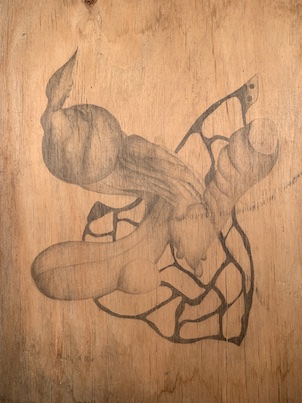
My artwork includes drawings, photography, and acrylic paintings.
- Self-portrait
- In the Woods

- Departure for an Adventure: Mykonos, Greece
- Alps Sunset: Schneefernerhaus, Garmisch-Partenkirchen, Germany